B2 · Capitolul 1 din 15
Platform One
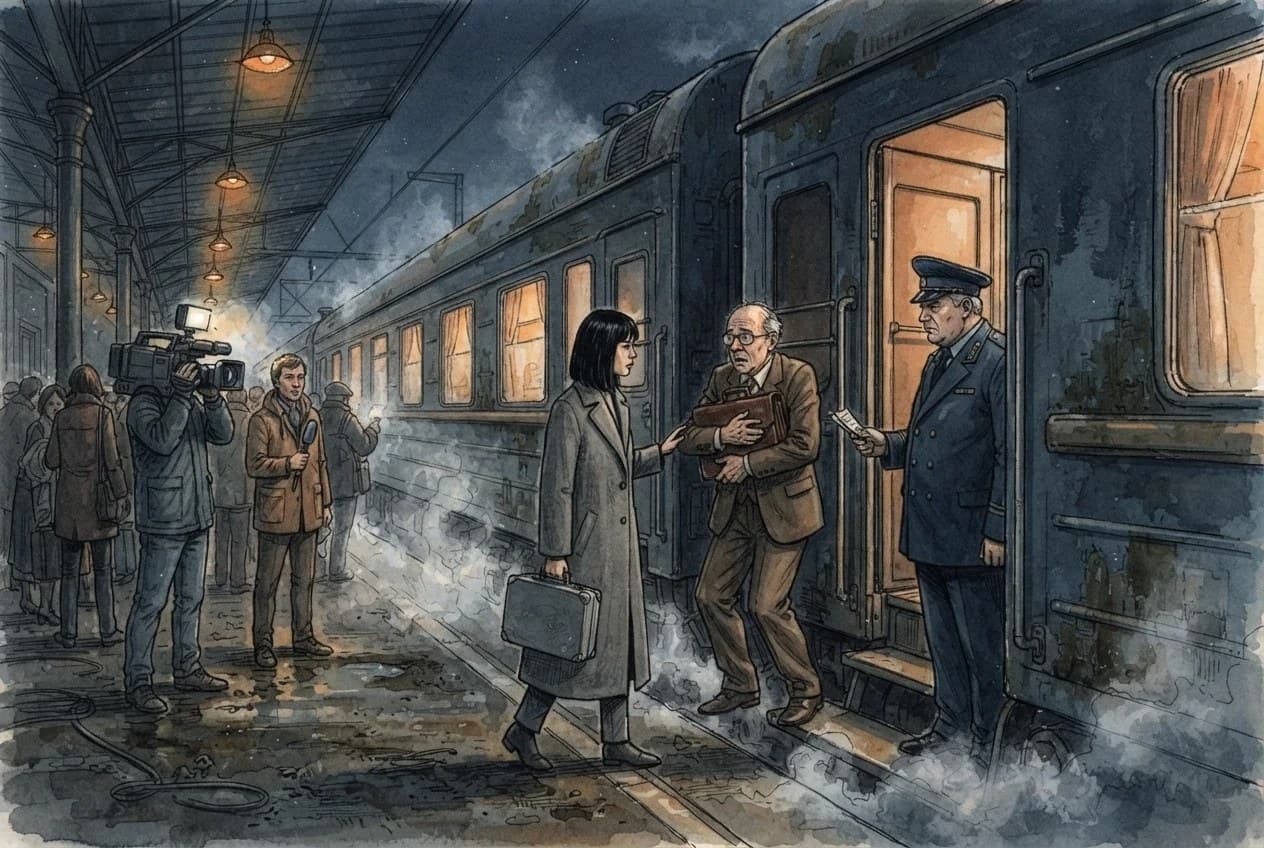
The night train to Bucharest left Chișinău at a quarter to eight, and on that particular Thursday in November everybody on the platform seemed to know that it would be the last one for a long time.
The railway company had announced it a month earlier in a short, apologetic notice: from the following day, the line would close for six months of urgent repairs. The old bridges needed strengthening, the tracks needed replacing, and the sleeping cars — which had been built in East Germany in the year Teodora Rusnac was born — needed, in the words of one newspaper, “either a museum or a miracle”. Buses would replace the train. Nobody believed the buses would be as good.
So the platform was busier than usual. There were students going back to universities in Iași and Bucharest, grandmothers with enormous bags of homemade food, a few railway enthusiasts photographing the locomotive as if it were a dying celebrity, and a television crew interviewing anybody who would stand still long enough.
Teo did not stand still. She walked quickly along the platform with a small grey suitcase, checking the numbers on the dark-blue carriages against the ticket on her phone. She was forty-one, tall, with straight black hair cut short at the jaw and the kind of calm, slightly tired face that made strangers ask her for directions. She was a forensic accountant — a job that, when she explained it at parties, usually produced one of two reactions. Either people’s eyes glazed over, or they became very interested and asked whether she could find out what their brother-in-law really earned.
What she actually did was simpler and more complicated than that. Companies, banks and sometimes governments hired her to look at their numbers and find out where money had gone that should not have gone anywhere. She followed money the way a hunter follows tracks in the snow. She was good at it. Tomorrow afternoon she was due to give a talk at a conference in Bucharest on the detection of financial fraud in public building contracts, and she intended to spend the evening revising her notes and the night asleep.
Carriage 4 was the sleeping car. At its door stood the conductor, a heavy man of about sixty in a dark-blue uniform that had been made for a slightly thinner man. His name badge said I. Botnaru. He checked her ticket and her passport with the slow seriousness of someone who had done it fifty thousand times.
“Compartment six, madam. Upper and lower berth, but you have the whole compartment to yourself. Tea is free until ten. After ten, it costs money.” He handed back her passport. “Last train,” he added, more quietly, as if to himself. “Thirty-one years on this line. And now — buses.”
The corridor of the sleeping car was narrow, with a faded red carpet, brass handles polished by decades of hands and a row of windows on one side. On the other side were nine doors, each leading to a compartment with two narrow beds, one above the other, a small table under the window and a mirror on the back of the door. It smelled of old wood, coal from the samovar at the end of the corridor and somebody’s orange peel.
Teo found number six and was about to open it when the door of number seven, next to hers, opened, and a man stepped out into the corridor and almost walked into her.
“Sorry,” he said in Romanian. “I’m so sorry—”
Then he stopped. He looked at her face for a second too long, and she saw something change in his eyes. Recognition. And then something else, which she could not name at first, and which she later understood was fear.
He was in his late fifties, of medium height, with thinning grey hair, rimless glasses and a good but slightly old-fashioned brown suit. He held a leather briefcase against his chest with both arms, as if it were a child in a crowd.
“Mrs. Rusnac,” he said. “Teodora Rusnac. From the audit.”
It took her a moment. Then she remembered: six years ago, a three-week audit of a road-building company called Drumul Nou Construct. A large, cold office on the edge of the city. A chief accountant who had answered every question politely, completely and without once looking her in the eye.
“Mr. Munteanu,” she said. “Pavel Munteanu. What a coincidence.”
“Yes,” he said. “A coincidence.” He did not sound as if he believed in coincidences.
There was a short, awkward silence. A student squeezed past them with a guitar. Somewhere outside a whistle blew.
“You wrote in your report,” said Munteanu suddenly, in a low voice, “that the company’s records were ‘complete and correctly presented, but that certain payments to subcontractors could not be fully verified’. I remember every word. Do you remember writing it?”
She did. She remembered, too, the feeling she had had in that cold office — the feeling that the numbers were too tidy, like a room that has been cleaned just before the police arrive. But she had found nothing she could prove, and an auditor writes only what she can prove.
“I remember,” she said.
“You were right,” said Munteanu. He looked quickly along the corridor in both directions. “You were right to be suspicious. I couldn’t tell you then. I had a family. I was afraid.” He held the briefcase tighter. “I am still afraid. But I am going to Bucharest tonight to tell somebody. Somebody who can do something about it.”
Teo felt the hair rise on the back of her neck. “Mr. Munteanu, if you are in danger, you should go to the police—”
“Which police?” He laughed, a short, unhappy sound. “Mrs. Rusnac, my employer has built half the roads in this country. Do you know how many people a man like that knows?” He took a breath. “Listen. If anything happens to me tonight — anything — remember this. The documents are not where they think they are.”
“Who are ‘they’?”
But the door at the end of the corridor opened, a group of passengers came in with their luggage, and Munteanu stepped back into compartment seven and closed the door. She heard the lock click.
Teo stood in the corridor for a moment, holding her suitcase. Then she went into her own compartment, sat down on the lower berth and looked out of the window at the people on the platform, the television lights, the station clock showing 19:43.
The documents are not where they think they are.
At 19:45 exactly, with a long, mournful whistle, the last train to Bucharest began to move.
Verifică-te
- Why is this train called “the last train”?
- What does Pavel Munteanu ask Teo to remember?